

HN Summary
• Faster syphilis testing: An HHS-led pilot is studying a five-minute finger-prick test for syphilis and HIV, allowing pregnant patients who test positive to receive immediate treatment and helping prevent congenital syphilis.
• Removing barriers: The test is being offered through low-barrier prenatal care and community outreach programs, targeting people who may face challenges accessing traditional screening. More than 80 per cent offered the test have accepted it.
• Responding to rising rates: With Hamilton syphilis rates increasing more than 300 per cent over the past decade, researchers hope to expand rapid testing and advocate for provincial funding.
Back when Dr. Laura Erdman was in medical school, very little was taught to Canada’s future doctors about diagnosing and treating congenital syphilis, and with good reason. This serious infection, which happens when a baby gets the syphilis bacteria from their birthing parent during pregnancy or childbirth, had been nearly wiped out nation-wide, so most doctors never expected to see a case in their careers.
But after decades of being almost eradicated, congenital syphilis has been making a dangerous comeback. At Hamilton Health Sciences’ (HHS) McMaster Children’s Hospital, where Erdman works as a pediatric infectious disease physician, teams have been seeing babies born with syphilis that went undetected or untreated in pregnancy.
For newborns with syphilis, the consequences can be dire and include organ failure and even death. If untreated, later in life they can develop blindness, deafness, brain damage and facial deformities. Untreated syphilis in pregnant people can also cause miscarriages or stillbirths.
Syphilis screening is routine in pregnancy, since this sexually-transmitted infection spreads silently and most people don’t know they have it. If syphilis infection is caught early and treated with an antibiotic, babies will be born healthy.
But not everyone gets routine screening because of barriers to prenatal care.
Turning challenges into solutions
Erdman, together with colleagues, began looking for ways to improve access to syphilis testing among pregnant people facing challenges like substance use, homelessness, and barriers to health care. Their goal is to prevent congenital syphilis in newborns, and also to prevent long-term complications of untreated syphilis in women who face barriers to health care.
This led to a one-year pilot study by Erdman and her research partner Dr. Suzanne Turner, a family physician who runs a clinic at the Maternity Centre of Hamilton in the city’s core that combines prenatal care and substance-use management. Other key partners are McMaster University, YWCA Hamilton, De dwa da dehs nye>s Aboriginal Health Centre, and community members with lived experience. “It’s a very collaborative project that tries to center community needs and voices,” says Erdman.
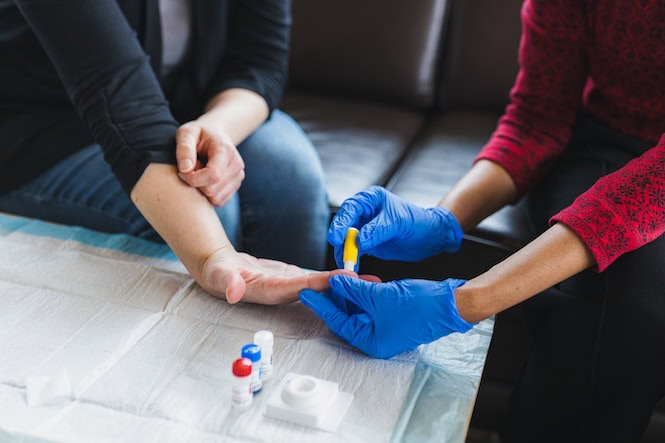
Central to the study is a simple finger-prick blood test that checks for syphilis, with results in just five minutes. If someone tests positive, they can receive treatment on the spot. The test also checks for HIV.
It’s much faster than the current standard practice, where syphilis screening is part of routine prenatal care and involves a blood sample being sent to a lab, with results taking up to two weeks to come back.
“This quick, five-minute test removes barriers, because not everyone can be easily contacted about results or come back to a clinic for treatment,” says Erdman. “The idea is to bring rapid syphilis testing directly to the people who need it most, along with treatment. It’s about meeting people where they’re at.”
The rapid test is available free to patients at Turner’s clinic, where it’s being studied, and through arts-focused drop-in workshops run by the YWCA Hamilton at several locations including shelters for women and gender-diverse people. Workshops include an arts project, snacks, syphilis prevention information, and an opportunity to get tested.
Rising rates
Over the past decade, syphilis rates in Hamilton have increased by more than 300 per cent, according to Hamilton Public Health’s 2024 Community Health Status Report. While syphilis mostly impacts males, local data show an increasing trend emerging among females.
“Rising syphilis rates appear to be tied to the opioid epidemic and methamphetamine use,” says Erdman, adding that the fastest rise in cases is in women of childbearing age, in their 20s and 30s. People who take drugs with a shared needle are at higher risk. But because of broad community spread, anyone who is sexually active could have syphilis.
Public Health doesn’t collect data on cases of syphilis in pregnancy, so it’s difficult to know the scope of the problem, adds Erdman.
Findings so far
This pilot project launched in June 2025 with the goal of testing about 60 people in Turner’s clinic. Over 40 have been tested so far, with no positive syphilis results yet. “Finding no cases is good news,” says Erdman. “But we also know that syphilis is in our community, and babies are being born with this dangerous infection, so having data about the feasibility of rapid syphilis testing in this context is very important.”
So far, over 80 per cent of pregnant people who are offered the rapid syphilis test agree to take it. Researchers are asking them about their experience with the test and how this could be improved. Also, they are asking clinicians at Turner’s low-barrier clinic how they’re managing with fitting testing into their workload, and whether they’re finding it valuable.
“We’re also hoping to spread awareness of this test to other practitioners who provide prenatal care to people at risk of syphilis,” says Erdman, whose plans include advocating for ministry funding, since the test isn’t covered by OHIP. Clinics currently need to pay about $30 per test.
“That’s not affordable for most clinics that provide low-barrier prenatal care,” says Erdman.
Meeting people where they’re at
Steph Milliken, a McMaster University PhD social work student, runs the drop-in workshops through the YWCA Hamilton, focused on connecting people at risk of syphilis in pregnancy with information and testing.
“Our workshops have been well-received,” says Milliken, adding that they’ve been offered at nine locations in Hamilton’s core.
Stacy Roulston, a doula who does outreach work with the YWCA Hamilton, helps run the workshops. “People have been very receptive, as well as very open-minded and willing to learn more,” she says. “They asked a lot of questions too.”
Community co-researchers with lived experience have been partners in developing and delivering the workshops, which has been key to their success and impact, says Erdman.
Learning from low and middle-income countries
While the finger prick test was recently approved by Health Canada, low and middle-income countries have been using it for about 15 years as a way to quickly diagnose and treat pregnant people in remote areas.
In rural Africa, for example, a pregnant person may have to travel several hours to reach a health clinic for prenatal care and testing, making it especially important to have a rapid test with on-the-spot results so treatment can begin immediately.
“The availability of this test in Canada is a great example of reverse innovation, where a high-income country can adopt a solution developed in low and middle-income countries out of necessity and limited resources,” says Erdman.
Sharing findings
The research project was made possible thanks to a 2023 Canadian Institutes of Health Research operating grant, and a 2025 HHS Early Career Award is supporting the team to train other health-care professionals across the region and province in rapid syphilis testing.
“There’s a strong plan to share what’s learned, with the goal of improving how people access and receive care, and guiding future policy and practice,” says Erdman.