

HN Summary
• McMaster Children’s Hospital has introduced a unique pre-operative coordination model that brings specialists together in a single appointment to plan complex pediatric surgeries.
• The one-stop approach reduces hospital visits for families while improving communication, care planning and surgical preparation.
• Designed for children with complex medical needs, the program is helping streamline care and improve the patient and family experience.
All-in-one appointment model is unique in Ontario, and possibly Canada.
Raising a child with complex medical needs is a nonstop whirlwind for the Monahan family, and any support brings real relief.
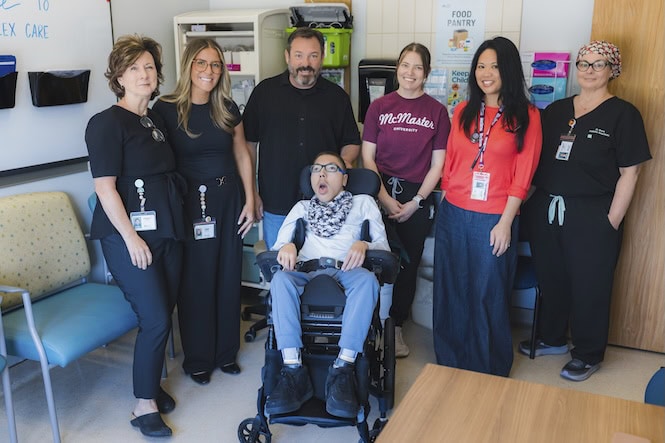
That’s why they welcomed an invitation from Hamilton Health Sciences’ McMaster Children’s Hospital (MCH) to take part in a comprehensive, one-time appointment with the doctors, nurses and team members from a wide range of specialties planning Joshua Monahan’s 12-hour spinal surgery last year. Joshua, then 16 years old, has been cared for by health-care teams at MCH since birth.
This one-stop appointment, by MCH’s pre-operative coordination care (POCCT) team, brings the child, family and key hospital team members together in one room to plan the best ways to support care leading up to a major surgery. This includes ordering any tests that would be needed, like bloodwork, MRIs or ultrasounds; discussing medications; and updating nutrition plans, all of which can help reduce the risk of complications afterwards.
MCH’s POCCT appointment model is unique in Ontario, and possibly also Canada, says HHS clinical manager Marta Wagner. “It’s an incredible example of teams working together for the best care for patients and their families.”
For families, the POCCT appointment turns what would have been multiple hospital visits over several weeks into an all-in-one meeting — cutting down on time away from school and work, travel, parking costs and stress. For the POCCT team, it means better, more efficient communication and planning.
“Having everyone in the same room at once is incredibly valuable,” says Joshua’s dad, Mark Monahan, adding that the surgery and recovery went smoothly.
“Joshua was all smiles when he was discharged 17 days after his surgery,” says Mark, adding that he also seemed happier and more comfortable. “And because his spine was straighter, he grew about 1.5 inches too.”
A POCCT appointment is reserved for MCH patients with complex medical needs who are undergoing complicated surgeries, says nurse practitioner Kristine Tomczyk, who works with MCH’s pediatric orthopedics department.
Examples of patients who could qualify include those with multiple medical complexities like cerebral palsy, respiratory needs, feeding tubes, a history of seizures, and/or developmental delays that need a complex operation like scoliosis correction or hip surgery.
The team currently offers POCCT appointments to 24 patients and their families each year. Patients are recommended by their surgeon, based on health concerns. Since a POCCT appointment is so in-depth, families receive a pre-meeting phone call, a letter explaining what to expect, and other materials to help them prepare.
What happens at a POCCT meeting?
The patient and their family meet with POCCT team members, which could include their surgeon, complex care team doctor, registered dietitian, pharmacist, physiotherapist, occupational therapist, dietitian, social worker, child life specialist and staff from the pediatric intensive care unit (PICU) and surgical unit.
Team members ask the family questions to help prepare for the surgery and hospital stay, and also answer any questions. An anesthetist meets with the family right before the meeting to discuss their child’s anesthetic and pain relief needs, and also attends the meeting, which lasts 60 to 90 minutes.
A family’s experience
Joshua and his twin brother Christopher, now 17, have lifelong complications from being born prematurely. Christopher weighed 1.9 lbs at birth and spent five months in the MCH neonatal intensive care unit (NICU), while Joshua weighed just 1.5 lbs and spent seven months in the NICU.
“Joshua’s early days and months were especially rocky,” says Mark, listing life-threatening sepsis, laser eye surgery, and two bowel surgeries as some of the many challenges Joshua faced as an infant in the NICU.
“Joshua had every setback you could imagine,” says Mark. “He was so sick at one point, we almost lost him. But he turned a corner and came back.”
Both teens are deaf as a result of their prematurity, and Joshua has additional lifelong challenges including being non-verbal, having cerebral palsy, and managing a neurological movement disorder that causes involuntary muscle contractions.
At age 16, Joshua was diagnosed with curvature of the spine and booked for scoliosis surgery. Scoliosis is a condition where the spine curves sideways, placing increasing pressure on the organs and skeletal system. Surgery to straighten the spine is complex and hours-long, and made even more challenging for patients like Joshua who have other complex medical conditions.
The Monahan family attended their POCCT appointment several weeks before Joshua’s surgery in March 2025, and got to meet with most of the people involved in planning. Several were familiar faces, since both boys have received care from MCH since birth.
“The team at McMaster Children’s Hospital are more than just doctors and nurses to us,” says Mark. “They’ve become like family and friends.”